
Investigating activation pathways of industry-critical Pd cross coupling pre-catalysts
Johnson Matthey(JM) is a global leader in platinum group metals (PGMs), with over 200 years of expertise in catalytic technologies. The company applies its deep knowledge of PGM chemistry to address some of the world’s most pressing challenges, from improving air quality to supporting more sustainable chemical manufacturing.
Johnson Matthey has partnered with the PINZ CDT on a project focused on improving the efficiency, robustness, and sustainability of processes that rely on homogeneous palladium pre-catalysts.
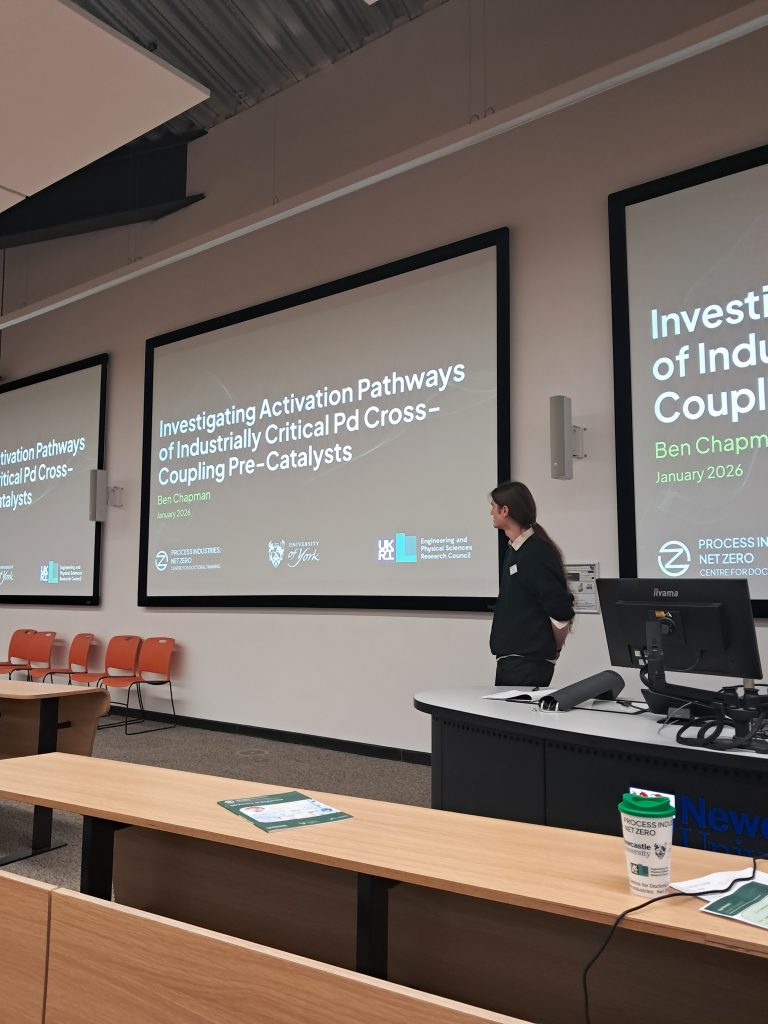
Based at the University of York, PhD researcher Ben Chapman, under the supervision of Professor Ian Fairlamb, is exploring chemical synthesis, pre-catalyst screening (supported by high-throughput experimentation and data analysis), and mechanistic studies of Pd-catalysed cross-coupling reactions.
Paula Chirila, Research Scientist at Johnson Matthey, explains more about the collaboration and its strategic importance.
What was the background to the project?
Cross-coupling reactions such as Suzuki–Miyaura and Buchwald–Hartwig are fundamental to the manufacture of high-value chemicals, including pharmaceuticals and agrochemicals. At Johnson Matthey, we are particularly interested in understanding how palladium pre-catalysts perform under industrially relevant conditions.
A key challenge is the activation of these pre-catalysts into their catalytically active forms. By gaining a deeper mechanistic understanding of these activation pathways, we can better design next-generation catalyst systems that are more efficient, selective, and robust.
This project aims to generate that understanding and ultimately support the development of improved cross-coupling technologies with reduced precious metal usage, lower waste, and enhanced process efficiency.
Why did Johnson Matthey choose to engage with the PINZ CDT?
Johnson Matthey has an established collaboration with Professor Ian Fairlamb and the University of York, and this opportunity through the PINZ CDT provided a natural extension of that relationship.
The CDT model offers a strong platform for bringing together academic insight with industrial application. It allows us to access cutting-edge research while ensuring the work remains aligned with real-world challenges and industrial needs.
The focus of the PINZ CDT on sustainability aligns closely with Johnson Matthey’s strategic priorities, including our commitment to supporting the transition to a more sustainable and low-carbon economy, as reflected in key UN Sustainable Development Goals such as good health and well-being (SDG 3), responsible consumption and production (SDG 12), and climate action (SDG 13).
How are the University of York’s facilities contributing to the project?
The collaboration combines complementary strengths. At Johnson Matthey, we bring expertise in PGM catalyst design, scale-up considerations, and industrial requirements. At the University
of York, Professor Fairlamb’s group brings strong expertise in mechanistic understanding and catalysis.
The university’s facilities play a key role in enabling the research. They are well equipped and shown themselves to be experts at the key technologies that will govern organic chemistry as well as organometallic chemistry. These include advanced spectroscopic capabilities (such as NMR), single-crystal X-ray diffraction for structural characterisation, and high-throughput experimentation platforms
How will a student benefit from undertaking a PhD through the PINZ CDT?
PINZ CDT offers a greater insight into both academia and industry, which gives the student a broader view of the life of a scientist in the academic and industry environments. In addition to core scientific training, the programme offers exposure to areas such as green chemistry, sustainability, and digitalisation.
Below: PINZ CDT PhD Researcher, Ben Chapman
Optimizing Pulse-Jet Cleaning for Sustainable Energy: A CFD Approach to Emissions Control
Founded in 1977, Durham Filtration originally set out to service the oil and gas sector with compressed air and air filtration products.
Since those early days, the company – which is based in Jarrow, Tyne and Wear – has grown to serve sectors including food and beverage, pharmaceuticals, chemical processing and power generation.
It has partnered with the PINZ CDT on a project which seeks to advance pulse-jet cleaning systems for flue gas treatment emissions control in waste-to-energy and biomass combustion plants.
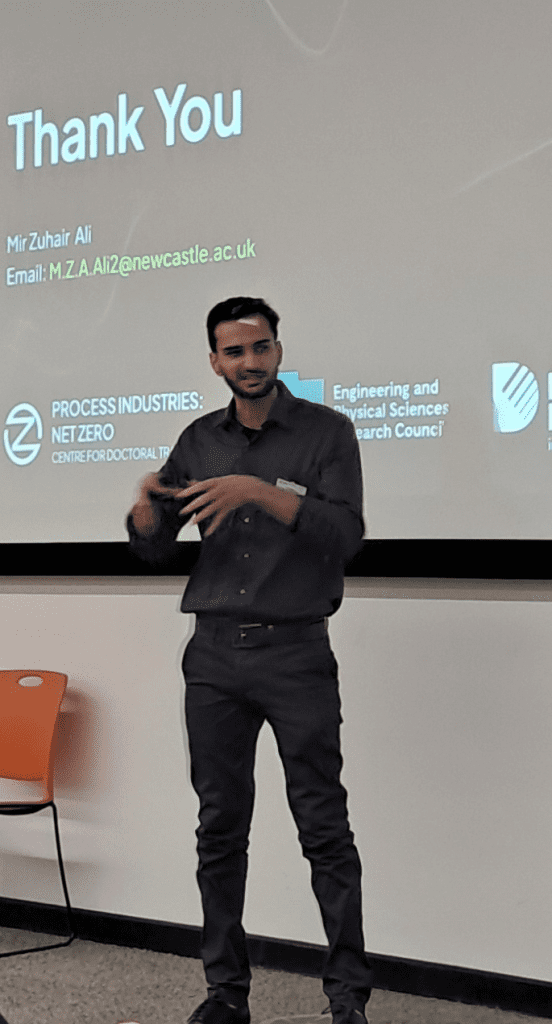
Based at Newcastle University, PhD researcher Mir Zuhair Ali is exploring how to move pulse-jet cleaning systems technology forward through using Computational Fluid Dynamics (CFD) methodologies for optimising filter cleaning processes. The end goal is enhancing filtration efficiency, reducing emissions, and improving the sustainability of energy production – aligning with both partners’ commitment to tackling climate change.
The results will feed directly into real-world applications by leveraging tools such as generative design, CAD/CAM and 3D printing.
Barry Goulden, Managing Director of Durham Filtration, explores his company’s partnership with the PINZ CDT – and the difference it is making.
How did your relationship with the PINZ CDT begin?
We undertook a knowledge transfer partnership with Newcastle University to look at how we could apply our existing filtration expertise to the biomass sector. That was highly successful, and the researcher who led that became our technical director, so we then decided that each year we would take a PhD student on, to bring more academic learning into the business.
Tell us more about the project…
Pulse jet bag filters are used to prevent ash, from the combustion of fuel, being emitted into the atmosphere. The filters are regenerative, with ash being deposited on the outside of the filter and periodically knocked off, for disposal, with pulses of compressed air. The project is looking at how this system can be designed in the most efficient way, with the optimal use of compressed air within the system.
How is Mir benefiting from working on a project through the PINZ CDT?
He’s working on real problems. For instance, he’s been able to work with one of our customers whose pulse jets have been performing poorly. That has entailed going on site visits, interacting with the customer, and being part of the wider discussion, so the project is helping him to integrate directly with industry.
Sometimes as an academic it can be difficult to understand the commercial world. But through the PINZ CDT, Mir is gaining an understanding of the commercial benefit of what he’s doing and the tangible benefits to the customer. He can see at first-hand how the pieces of the jigsaw fit together.
What particular capability, available through the PINZ CDT, is the project drawing on?
One of the most beneficial aspects is access to Newcastle University’s Rocket HPC (High Performance Computing) service. We can run the simulations we need to carry out on desktop computers, but that takes an enormous amount of time, which means you need to make compromises. Having access to the HPC systems means simulations can be run much more quickly and with a greater amount of detail. It reduces the turnaround times.
What has impressed you about working with Newcastle University’s Process Improvement Group on the project? Why should an SME with similar goals to Durham Filtration partner with the PINZ CDT?
The supervising doctors and professors see the world through very similar eyes to us in terms of the technology. It wasn’t a case of trying to get them on board – they contributed from day one.
If you’re an SME embarking on a project such as this, it can be a big step. If you pick the wrong institution to partner with, you may never do it again. But the team at Newcastle have been very proactive. And they really believe that everyone involved – the student, business and university – should benefit. They are very focused on collaboration within industry. For students aiming for careers in industry, programmes like the PINZ CDT offer excellent preparation and valuable professional experience.
Below: PINZ CDT PhD Researcher, Mir Zuhair Ali
Development of Water-Soluble and Biodegradable Detergent Ingredients from CO2 and Biorenewable Sources
How can sustainability be enhanced in the design and manufacturing of fast-moving consumer goods? This is the challenge driving a project co-funded by Procter & Gamble, which focuses on the development of novel renewable and biodegradable water-soluble ingredients for fabric and home care products.
PhD researcher Vaishnavi Jambhorkar, under the supervision of Dr Fernando Russo Abegão and Professor Kamelia Boodhoo at Newcastle University, is investigating biorenewable platform molecules, with a focus on catalysis, molecular functionality design, and production pathway development.
Gang Si, Director Principle Scientist at Procter and Gamble, sheds more light on this fascinating project, and why the company is partnering with the PINZ CDT.
What was the background to the project
P&G is committed to sustainability. Our ambition is to reach net zero greenhouse gas (GHG) emissions across our supply chain and operations, from raw material to retailer, by 2040.
The company is interested in using recycled CO2 as a chemical building block for consumer goods. CO2 is already used as a feedstock in other sectors, ranging from circular chemicals to advanced materials. P&G sought to explore how this concept could be applied within its own industry.
Why did Procter and Gamble choose to engage with the PINZ CDT?
Renewable and circular feedstocks are a central theme of the PINZ CDT and align closely with P&G’s goals. However, developing efficient manufacturing processes using these novel building blocks and chemistries presents significant challenges. Beyond production routes, considerations include formulation stability, product performance, and environmental fate.
Newcastle University’s Process Intensification Group has extensive expertise in renewable feedstock conversion, catalysis, and intensified process technologies. The PINZ CDT’s focus on net zero technologies and sustainability makes it an ideal partner.
For complex upstream projects like this, the CDT provides a holistic framework to assess multiple technologies and platform chemistries, combining laboratory experimentation with product performance testing and sustainability assessment.
How are Newcastle University’s facilities contributing to the project?
Assembling the equipment and capabilities needed to undertake this research from scratch would require significant upfront investment. Newcastle University provides access to state-of-the-art laboratory equipment for reaction screening and process development, as well as molecular quantification and structural characterisation tools, such as high-field NMR, mass spectroscopy, and chromatography systems. These resources are vital to the success of the research.
How will a student benefit from undertaking a PhD through the PINZ CDT?
Doctoral training programmes like the PINZ CDT are university-led but involve strong industrial collaboration. They provide students with end-to-end experience. For example, a student may synthesise compounds at the university, then later formulate these into a product and conduct performance testing that simulates real consumer use.
As projects progress toward application testing, collaboration with industrial colleagues becomes critical. This exposure to cross-functional teamwork mirrors real industry practice.
For students aiming for careers in industry, programmes like the PINZ CDT offer excellent preparation and valuable professional experience.
To learn more about P&G UK and Ireland, its brands and citizenship programmes please visit www.pg.co.uk, and follow its social channels (Instagram @pgukandireland, LinkedIn Procter & Gamble UK & Ireland).

Process intensification – defined as “a significant reduction in the size of process equipment without affecting production targets” – can play a major role in the UK’s drive to Net Zero. Put simply, it means ‘doing the same thing’, but with process equipment 10s or 100s of times smaller, generating many benefits for industry and the environment.
The original concept was developed at ICI during the 1970s, where the goal was to reduce the capital cost of production systems.
But the benefits are far wider: process intensification can make process plants more environmentally friendly, flexible and adaptive to market demand. Lower CapEx and OpEx, reduced energy and resource use, less waste, a minimised plant footprint, safer operations and improved process control are just some of the advantages.
The Process Intensification Group
Established in 2005, Newcastle University’s Process Intensification Group – part of the School of Engineering – is leading the way in supporting industry in adopting process intensification methods and technology.
The group specialises in many areas of process intensification. These include reaction, separation and heat exchange technologies, plus the application of process intensification approaches to equipment design and process synthesis.
Carbon Capture: An example of its work is the development of Rotating Packed Bed (RPB) technology for intensified CO2 capture, which is now commercially available. It reduces the size of carbon capture columns by a factor of ~30. A conventional column might be tens of metres tall, and need substantial civil engineering support – however that need becomes redundant due to the scale of RPB technology.
The Process Intensification Group’s work has applications across all process industries, including chemical manufacturing, food and beverage processing, energy, pharmaceutical manufacturing and utilities, notably the water industry.
As one of the two collaborative partners behind the PINZ CDT along with the University of York’s Green Chemistry Centre for Excellence, the Process Intensification Group is providing a unique blend of academic expertise and state-of-the-art facilities, and enabling researchers to develop their skills at the leading edge of process industry innovation.
A hub of process intensification knowledge
Led by Professor Adam Harvey, Professor of Process Intensification at Newcastle University, the Process Intensification Group has grown from seven team members at its inception to a group of more than 60 active researchers: 18 academic staff, 10 PRDAs and more than 40 PhD students.
Companies partnering with the PINZ CDT on co-created projects can therefore tap into a deep well of process sector knowledge, spanning multiple disciplines across energy, feedstocks and data.
These areas of expertise include:
3D printing
Algae processing
Biocomposites
Biorefining
Biofuels
Brewing
Data modelling
Flow chemistry
Heat transfer
Heterogeneous catalysis
Non-thermal plasmas
Process control
Reaction engineering
Thermal management
Thermochemical processes
Waste heat recovery
Water treatment
State-of-the-art facilities
Engaging with the PINZ CDT on a project opens up a vast array of specialist equipment to industry partners, and provides access to world-leading facilities at Newcastle University.
For example, through the Process Intensification Group, researchers can access Newcastle University’s pilot plant scale rotating packed beds and CO2 absorbent screening technology: this can be of major benefit to companies working in industrial carbon capture.
Another key technology available at Newcastle University is the oscillatory baffled reactor (OBR), which is used to accommodate long residence time processes, and is a more efficient alternative to continuous stirred tank reactors (CSTRs) and plug flow reactors (PFRs). Its applications include fermentation, biodiesel production, wastewater treatment and liquid-liquid, liquid-gas and liquid-solid reactions.
Newcastle University’s OBR is part of a suite of reactor technology that includes spinning disc reactors, Multicell 8 high pressure reactors, a CoFlore agitated cell reactor, non-thermal plasma reactors, a batch photoreactor, a gas bubbling column photoreactor and a Taylor-Couette reactor.
Additional core facilities supporting the Process Intensification Group’s research include a dedicated 3d printing lab, Micro Fluidized Beds/a Micro-TORBED for CO2 adsorbent screening, foam flotation columns, a heat pipe extruder, and a comprehensive array of analytical equipment, such as UV-Vis Diffusive Reflectance Spectroscopy equipment, UV/Vis Spectrophotometers and FTIR Spectrometers.
Newcastle University also has its own student-run brewery (Europe’s first), which works in partnership with the School of Engineering to act as a research unit for sustainable brewery design. It works closely with academics from the school and other microbreweries to improve processes and share best practice.
And partnering with the PINZ CDT opens the door to Newcastle University’s wider capabilities, from specialist laboratories hosted by the North East Centre for Energy Materials (including mass spectrometry and NMR spectroscopy) to high performance computing for data-intensive research.
Making processes safer, cleaner and more efficient
Through its work with the PINZ CDT, the Process Intensification Group is helping a wide range of organisations – from emerging innovators to major utilities providers – advance their work and explore new solutions.
Optimizing Pulse-Jet Cleaning for Sustainable Energy: A CFD Approach to Emissions Control, with Durham Filtration – this project aims to advance pulse-jet cleaning systems for flue gas treatment emissions control in waste-to-energy and biomass combustion plants, with a Net Zero goal of saving energy in particle filtration. It’s exploring Computational Fluid Dynamics (CFD) methodologies for optimising filter cleaning processes, and leveraging tools such as generative design, CAD/CAM and 3D printing.
Towards Net Zero by optimising thermal energy recovery and management in the waste-water sector, with Northumbrian Water Ltd – this is an investigation into the feasibility of recovering low-grade waste heat in the waste-water sector, via a comprehensive modelling and optimisation study, with the Net Zero Goal of reducing energy use by optimising heat use.
Bioprocess Intensification for Carbon Dioxide and Waste-derived Feedstock Conversion to Bio-based Products, with Biofuel Evolution Ltd and CPI – this project is investigating the biological conversion of captured carbon dioxide and waste-derived feedstocks into renewable products. The Net Zero goal is the replacement of fossil fuel-derived feedstocks with CO2 or waste.
Optimisation of the cryogenic bulk liquid production and supply market, with BOC Linde – this project aims to create an optimisation strategy for bulk liquid production, accounting for the supply market for liquid oxygen, nitrogen and argon, and factors including customer demands, electricity spot market prices, and Net Zero objectives. The Net Zero goal of this project is to reduce energy use, and optimise the use of renewable electricity.
Want to explore how you can uncover new solutions, develop your own industry-ready Net Zero specialists, and move your innovations forward with the support of The Process Intensification Group and The Green Chemistry Centre for Excellence?
Contact pinz.cdt@newcastle.ac.uk

Tackling global challenges – exploring The Green Chemistry Centre of Excellence
As the process sector’s Net Zero journey evolves, there is a growing need for the adoption of greener and cleaner processes, and green product design.
According to the International Energy Agency, the chemical industry is the third largest industry subsector in terms of direct CO2 emissions, and there is pressure on the sector to reduce its carbon footprint, as well as minimise other environmental impacts.
Building expertise in green chemistry – the design of chemical products and processes that reduce or eliminate the use and generation of hazardous substances – can play a key role in helping industry step up to these challenges.
The Green Chemistry Centre of Excellence
Part of the University of York, the Green Chemistry Centre of Excellence (GCCE) is a world-leading academic facility for pioneering pure and applied green and sustainable chemical research. It’s an international flagship, providing innovative solutions for a circular, sustainable economy, and works closely with the chemical, energy, food, pharmaceutical and related industries.
The GCCE is led by Professor Helen Sneddon, and has more than 20 years of experience in green chemistry, and is one of two collaborative partners behind the PINZ CDT along with the Process Intensification Group at Newcastle University. Their combined academic strengths and state-of-the-art facilities are at the heart of the PINZ CDT’s work in contributing to safer, cleaner and more efficient processes, and training the next generation of process sector talent.
The GCCE’s track record of interfacing with industry is extensive… and its recent work on polymer research is just one example of this. With backing from the Engineering and Physical Sciences Research Council (EPSRC)’s Prosperity Partnerships programme, the GCCE is collaborating with Croda International Plc and The University of Nottingham to develop novel, sustainable polymers for liquid formulations, and is partnering with Synthomer to develop biobased polymers using feedstocks that do not compete with food.
A hotbed of green chemistry expertise
More than 60 members make up the GCCE, with a team of academic staff supported by a group of postdoctoral researchers. And the centre is home to world-renowned green chemistry experts, who are at the forefront of their fields. The centre collaborates with academics across the Department of Chemistry and University more widely aligned with its research areas and purpose.
The GCCE’s core research areas are:
Renewable feedstocks The centre has built up a strong track-record of valorisation of biobased feedstocks into chemicals, materials and (bio)energy. It has pioneered research into the use of microwaves to selectively activate components of biomass, leading to more controlled decomposition processes.
Green synthesis The GCCE team are undertaking research to develop more benign reaction protocols for common synthetic transformations, and champion the synthesis of bio-derived platform molecules and their conversion to sustainable products.
Sustainable technologies The GCCE is exploring where technologies such as enzyme catalysis, microwave processing, flow chemistry, and mechanochemistry can provide tangible sustainability benefits over current manufacturing protocols.
Design for reuse / degradation / recovery The GCCE works with partners to design biodegradable polymers, and explore the impact of polymers in anaerobic digesters, and conducts research into the recovery of valuable and/or harmful components from the environment.
Facilities to transform research
Engaging with the PINZ CDT opens the door to a wealth of facilities at The University of York, giving industry partners the technology and equipment they need to expand and accelerate research.
The suite of specialist reactors available through the GCCE include high pressure, supercritical carbon dioxide reactor, microwave, membrane and multipoint reactors, and its analytical capabilities include: X-ray photoelectron spectroscopy; UV-visible spectroscopy; thermal analysis; IR spectroscopy; porosimetry; NMR; high performance liquid chromatography; gas chromatography; and powder and crystal X-ray diffraction.
Research into the application of microwave technology is supported by the centre’s dedicated laboratory scale microwave facility, where reactions can be taken from 1mL to 1000mL scale under hydrolysis or pyrolysis conditions.
In addition, PINZ CDT industry partners can access the Biorenewables Development Centre, a research, development and demonstration biorefining centre, founded from a partnership between the GCCE and the University of York’s Centre for Novel Agricultural Products. The Biorenewables Development Centre develops methods at the laboratory scale, and scales-up processes to demonstrate their commercial potential, typically at the 1-100 litre or 1-100 kg scale. Its capabilities are wide-ranging: raw materials characterisation, system development, processing and product evaluation are supported by a suite of equipment including pilot-scale continuous centrifuges, HPLC and ICP-MS systems, bioreactors, thermochemical equipment and a Flavourtech spinning cone.
And researchers can also draw on the instrumentation and expertise of the York Centre of Excellence in Mass Spectrometry (CoEMS), and The Wolfson Atmospheric Chemistry Laboratories, a collaborative venture between the University of York and the National Centre for Atmospheric Science (NCAS) which enables studies relating to the science of air pollution, stratospheric ozone depletion and climate change.
Advancing the development of sustainable feedstocsk and innovative chemistries
The GCCE is supporting ground-breaking research projects through the PINZ CDT and is helping organisations – from specialist lab equipment providers to multinational consumer goods manufacturers – move innovations forward and unlock new opportunities.
Below are some of the projects which are drawing on the GCCE’s expertise and facilities.
Accelerating catalytic reaction optimisation through an innovative reactor design for high throughput experimentation, with Labman Automation – this project collaboration is developing novel metal-free catalysis for the preparation of functional fluorinated molecules, and involve synthesis, catalyst development and mechanistic studies.
Greener Solvents for more sustainable processes, with Reckitt – a PhD project which aims to modernise the practice of green solution chemistry by applying statistical thermodynamic fluctuation theory to the practice of solvent substitution.
Revolutionising High-Throughput Experimentation for Sustainable Catalysis, with Johnson Matthey – a project that addresses the challenges in reproducibility and scalability in HTE, by investigating the HTE workflow and focusing on Suzuki-Miyaura cross-coupling (SMCC) and Buchwald-Hartwig amination (BHA) reactions.
Ethyl Lactate as a Green Solvent – Processes, Performance and Air Quality Impacts, With Thomas Swan – focusing on the bioderived solvent, Ethyl lactate, this project will look at solvent benchmarking experiments across a range of applications, green synthetic chemistry and simulations.
Find out how you can uncover new solutions, develop your own Net Zero specialists, and move your innovations forward with the support of The Process Intensification Group and The Green Chemistry Centre of Excellence.
Contact: pinz.cdt@newcastle.ac.uk

Bioprocess Intensification for Carbon Dioxide and Waste-derived Feedstock Conversion to Bio-based Products
Coventry-based start-up Biofuel Evolution has a mission: to fuel a circular bio-economy and support the bio-based industry’s growth, with the ultimate aim of reducing global environmental impacts.
It wants to achieve this through BEBlock®, a solution which will integrate bioprocess engineering and bioelectrochemical systems to develop novel biological pathways for waste conversion: rather than relying on food crops, the technology will instead transform organic waste streams into valuable products.
Biofuel Evolution is now partnering with the PINZ CDT to move this solution forward.
PhD student Louise Amor-Seabrooke, under supervision from Dr Sharon Velasquez-Orta and Professor Adam Harvey of Newcastle University’s Process Intensification Group, is investigating the biological conversion of captured carbon dioxide and waste-derived feedstocks into renewable products.
In this project, data analytics will be used to map the composition of waste-derived feedstocks across domestic and global geographic regions to examine how seasonality might affect their characteristics, and how waste streams differ geographically. Highly characterised biocatalysts, microorganisms, and microbial consortia will then be designed, evolved and optimised highly to convert waste-based feedstocks into new products.
Jaymish Patel, co-founder and CEO of Biofuel Evolution, explains how the PINZ CDT project is helping the company break new ground…
How did the initial relationship with the PINZ CDT come about?
We worked on an Innovate UK Transformative Technologies project with a research team led by Dr Sharon Velasquez-Orta, which enabled us undertake the initial feasibility assessment of the technology and its potential.
What does this project mean for the evolution of your technology?
Having support from a renowned institution such as Newcastle University has given us the opportunity to elevate the technology and reach the next milestones that that we need to hit.
Our vision is to make sustainable resources and energy accessible to the world, through innovation, inspiration and education – and his project really emphasizes that.
What are the advantages of partnering with the PINZ CDT?
The academics involved are highly specialized. They are some of the best not only in the country, but in the world. Dr Velasquez-Orta, for example, has a great breadth of knowledge in bioelectrochemical systems, waste remediation and valorization, and that was one of the reasons why we decided to pursue this project with the PINZ CDT.
The involvement of York University is also a major benefit. Its Biorenewables Research Centre will allow us to translate the research findings to pilot scale.
Overall, the PINZ CDT offers a great blend of technical expertise and industry knowledge.
How is the project supporting Louise Amor-Seabrooke’s development?
In our first few conversations with Louise, we could see that she had the passion and drive to really make a difference, and this project is providing a platform for her to enhance her knowledge.
PINZ CDT has not only given Louise the opportunity to develop more in-depth capabilities in areas such as data coding and biochemical engineering processes but has also helped her to develop soft skills – for instance in public speaking.
Why should a start-up company, at a similar stage to Biofuel Evolution, engage with the PINZ CDT?
If you don’t have relevant resources in house, it can be very difficult to acquire them in a short space of time. The PINZ CDT provides access to those capabilities.
But in particular, it’s a doorway to an established ecosystem of expertise, and wide-ranging knowledge of how to scale-up projects and bridge the gap between academia and industry. That has been a huge help to us and will be to other companies who are on a similar journey in developing their own technologies.
