
PINZ CDT Dragon’s Den Net-Zero Challenge


Left: PINZ CDT PhD Researchers following the Dragon’s Den Net Zero Activity
Front row, l to r: Mohammad Hosseinpour, Abdul Samad, Aditya Tiwari, Alex Bradley, Kudzai Chiwara, Vaishnavi Jambhorkar, Aarcha Kalluparambil, Max Atkinson and Abubakar Kuburi; Back row, l to r: Kypros Iavokou, Sam Bury, Annabel Bowkett, Louise Amor-Seabrooke, Ben Chapman, Zuhair Ali, Robyn Haley, Amy Lumsdon, Salome Usakuhyel Raymond
Right: Dragon’s Den Net-Zero Prize Winners
L to R: Abdul Samad, Aditya Tiwari, Abubakar Kuburi, Alex Bradley, Vaishnavi Jambhorkar, Kyle McLean, Aarcha Kalluparambil & Max Atkinson
PINZ CDT PhD researchers from Newcastle University and the University of York recently put their innovation and communication skills to the test in a Dragon’s Den-inspired Net Zero Challenge.
This interactive training activity introduced the researchers to the fundamentals of pitching net-zero research and technology ideas to potential funders and investors. Working in small teams, they identified a climate or net-zero challenge, proposed a potential technology or research-based solution and prepared a short funding pitch.
Inspired by the popular Dragon’s Den format, each team presented their idea to a panel of judges, demonstrating not only the technical merit of their concepts but also the potential for real-world impact.
Prizes were awarded for the most convincing / investible pitch, for the biggest potential climate impact and for the most creative idea.
The challenge provided students with valuable experience in translating complex research into persuasive, audience focused pitches – an essential skill for securing support for future net-zero solutions.
Congratulations to the prize-winning teams
Most convincing / investible pitch: Max Atkinson, Aarcha Kalluparambil, Abubakar Kuburi
Biggest potential climate impact: Alex Bradley, Vaishnavi Jambhorkar, Kyle McLean
Most creative idea: Aditya Tiwari, Abdul Samad
Special thank you
Special thanks to our judging panel of experts: Dr Anna Zhenova, Founder & CEO of Green Rose Chemistry; Dr Jonathan McDonough, Lecturer in Process Intensification at Newcastle University and Dr Ryan Siddall, Innovation and Partnerships Manager at Newcastle University.
Investigating activation pathways of industry-critical Pd cross coupling pre-catalysts
Johnson Matthey(JM) is a global leader in platinum group metals (PGMs), with over 200 years of expertise in catalytic technologies. The company applies its deep knowledge of PGM chemistry to address some of the world’s most pressing challenges, from improving air quality to supporting more sustainable chemical manufacturing.
Johnson Matthey has partnered with the PINZ CDT on a project focused on improving the efficiency, robustness, and sustainability of processes that rely on homogeneous palladium pre-catalysts.
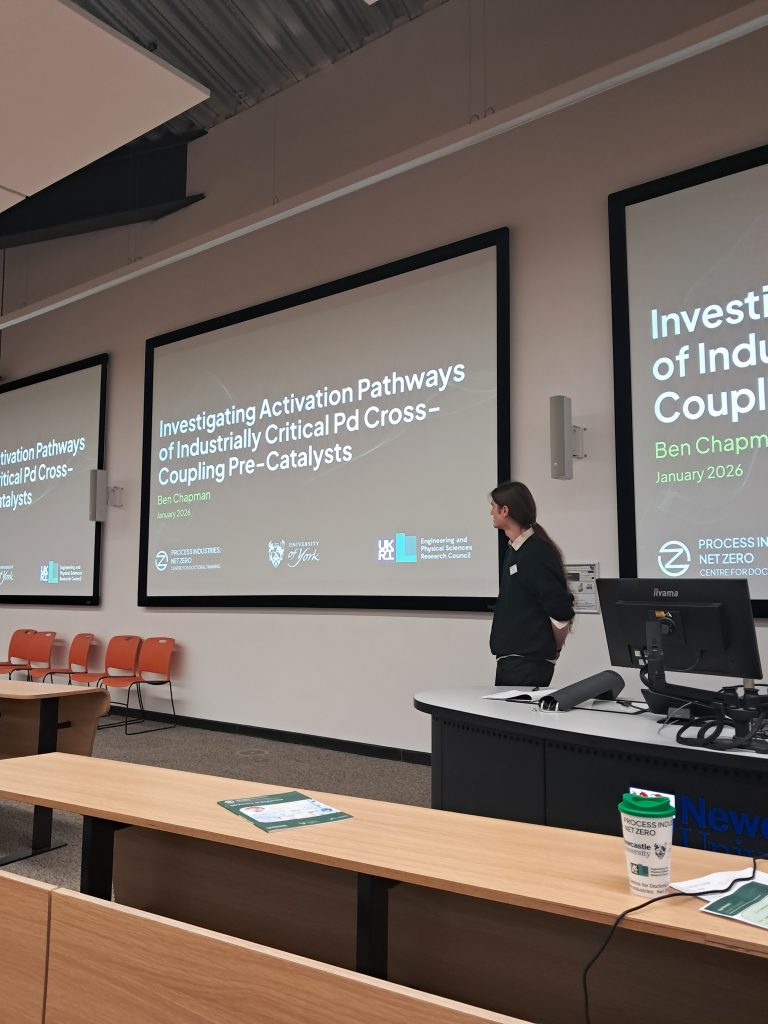
Based at the University of York, PhD researcher Ben Chapman, under the supervision of Professor Ian Fairlamb, is exploring chemical synthesis, pre-catalyst screening (supported by high-throughput experimentation and data analysis), and mechanistic studies of Pd-catalysed cross-coupling reactions.
Paula Chirila, Research Scientist at Johnson Matthey, explains more about the collaboration and its strategic importance.
What was the background to the project?
Cross-coupling reactions such as Suzuki–Miyaura and Buchwald–Hartwig are fundamental to the manufacture of high-value chemicals, including pharmaceuticals and agrochemicals. At Johnson Matthey, we are particularly interested in understanding how palladium pre-catalysts perform under industrially relevant conditions.
A key challenge is the activation of these pre-catalysts into their catalytically active forms. By gaining a deeper mechanistic understanding of these activation pathways, we can better design next-generation catalyst systems that are more efficient, selective, and robust.
This project aims to generate that understanding and ultimately support the development of improved cross-coupling technologies with reduced precious metal usage, lower waste, and enhanced process efficiency.
Why did Johnson Matthey choose to engage with the PINZ CDT?
Johnson Matthey has an established collaboration with Professor Ian Fairlamb and the University of York, and this opportunity through the PINZ CDT provided a natural extension of that relationship.
The CDT model offers a strong platform for bringing together academic insight with industrial application. It allows us to access cutting-edge research while ensuring the work remains aligned with real-world challenges and industrial needs.
The focus of the PINZ CDT on sustainability aligns closely with Johnson Matthey’s strategic priorities, including our commitment to supporting the transition to a more sustainable and low-carbon economy, as reflected in key UN Sustainable Development Goals such as good health and well-being (SDG 3), responsible consumption and production (SDG 12), and climate action (SDG 13).
How are the University of York’s facilities contributing to the project?
The collaboration combines complementary strengths. At Johnson Matthey, we bring expertise in PGM catalyst design, scale-up considerations, and industrial requirements. At the University
of York, Professor Fairlamb’s group brings strong expertise in mechanistic understanding and catalysis.
The university’s facilities play a key role in enabling the research. They are well equipped and shown themselves to be experts at the key technologies that will govern organic chemistry as well as organometallic chemistry. These include advanced spectroscopic capabilities (such as NMR), single-crystal X-ray diffraction for structural characterisation, and high-throughput experimentation platforms
How will a student benefit from undertaking a PhD through the PINZ CDT?
PINZ CDT offers a greater insight into both academia and industry, which gives the student a broader view of the life of a scientist in the academic and industry environments. In addition to core scientific training, the programme offers exposure to areas such as green chemistry, sustainability, and digitalisation.
Below: PINZ CDT PhD Researcher, Ben Chapman
Optimizing Pulse-Jet Cleaning for Sustainable Energy: A CFD Approach to Emissions Control
Founded in 1977, Durham Filtration originally set out to service the oil and gas sector with compressed air and air filtration products.
Since those early days, the company – which is based in Jarrow, Tyne and Wear – has grown to serve sectors including food and beverage, pharmaceuticals, chemical processing and power generation.
It has partnered with the PINZ CDT on a project which seeks to advance pulse-jet cleaning systems for flue gas treatment emissions control in waste-to-energy and biomass combustion plants.
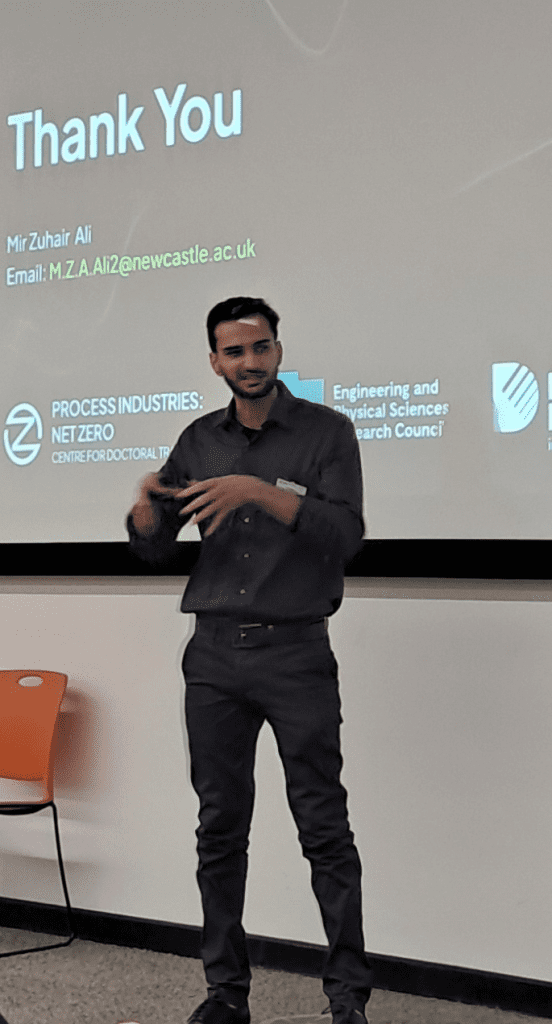
Based at Newcastle University, PhD researcher Mir Zuhair Ali is exploring how to move pulse-jet cleaning systems technology forward through using Computational Fluid Dynamics (CFD) methodologies for optimising filter cleaning processes. The end goal is enhancing filtration efficiency, reducing emissions, and improving the sustainability of energy production – aligning with both partners’ commitment to tackling climate change.
The results will feed directly into real-world applications by leveraging tools such as generative design, CAD/CAM and 3D printing.
Barry Goulden, Managing Director of Durham Filtration, explores his company’s partnership with the PINZ CDT – and the difference it is making.
How did your relationship with the PINZ CDT begin?
We undertook a knowledge transfer partnership with Newcastle University to look at how we could apply our existing filtration expertise to the biomass sector. That was highly successful, and the researcher who led that became our technical director, so we then decided that each year we would take a PhD student on, to bring more academic learning into the business.
Tell us more about the project…
Pulse jet bag filters are used to prevent ash, from the combustion of fuel, being emitted into the atmosphere. The filters are regenerative, with ash being deposited on the outside of the filter and periodically knocked off, for disposal, with pulses of compressed air. The project is looking at how this system can be designed in the most efficient way, with the optimal use of compressed air within the system.
How is Mir benefiting from working on a project through the PINZ CDT?
He’s working on real problems. For instance, he’s been able to work with one of our customers whose pulse jets have been performing poorly. That has entailed going on site visits, interacting with the customer, and being part of the wider discussion, so the project is helping him to integrate directly with industry.
Sometimes as an academic it can be difficult to understand the commercial world. But through the PINZ CDT, Mir is gaining an understanding of the commercial benefit of what he’s doing and the tangible benefits to the customer. He can see at first-hand how the pieces of the jigsaw fit together.
What particular capability, available through the PINZ CDT, is the project drawing on?
One of the most beneficial aspects is access to Newcastle University’s Rocket HPC (High Performance Computing) service. We can run the simulations we need to carry out on desktop computers, but that takes an enormous amount of time, which means you need to make compromises. Having access to the HPC systems means simulations can be run much more quickly and with a greater amount of detail. It reduces the turnaround times.
What has impressed you about working with Newcastle University’s Process Improvement Group on the project? Why should an SME with similar goals to Durham Filtration partner with the PINZ CDT?
The supervising doctors and professors see the world through very similar eyes to us in terms of the technology. It wasn’t a case of trying to get them on board – they contributed from day one.
If you’re an SME embarking on a project such as this, it can be a big step. If you pick the wrong institution to partner with, you may never do it again. But the team at Newcastle have been very proactive. And they really believe that everyone involved – the student, business and university – should benefit. They are very focused on collaboration within industry. For students aiming for careers in industry, programmes like the PINZ CDT offer excellent preparation and valuable professional experience.
Below: PINZ CDT PhD Researcher, Mir Zuhair Ali
A group of PINZ CDT Cohort 1 and Cohort 2 students recently represented the Centre at the Inter-CDT 2026 Conference, held at the University of Edinburgh.
The conference gave an excellent opportunity for students to showcase and discuss their research, exchange ideas and build valuable connections with PhD researchers from Centres for Doctoral Training across the UK.
Pictured below at the conference are (L to R): Kyle McClean, Louise Amor-Seabrooke, Abdul Samad, Amy Lumsdon, Kypros Iakovou, Robyn Haley and Dominic Gardiner.

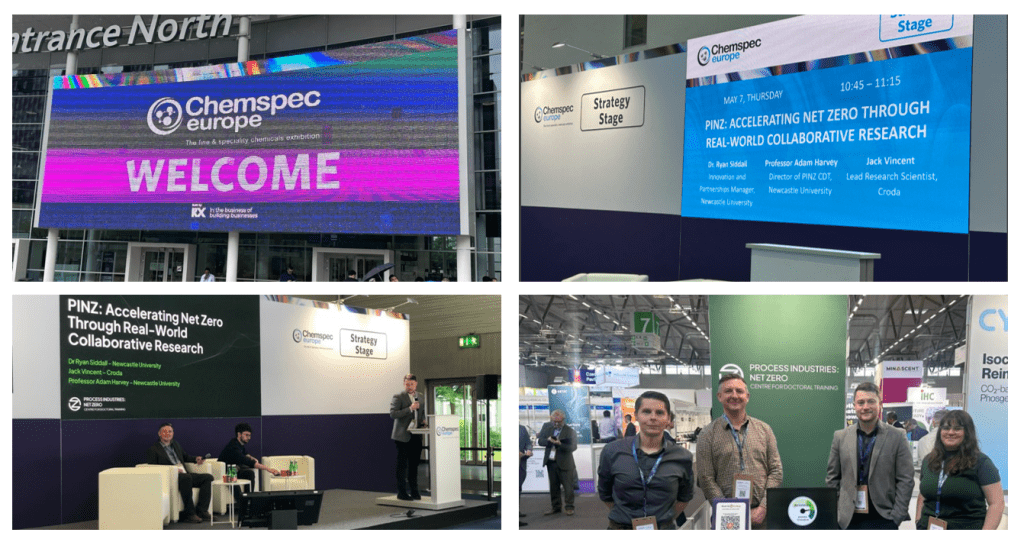
The PINZ CDT was represented at this week’s ChemSpec Europe Conference in Cologne by CDT Co-Director, Prof Adam Harvey, Academic Supervisor, Dr Jonathan McDonough, Innovation and Partnerships Manager, Dr Ryan Siddall of Newcastle University and University of York PhD researcher Hannah Chapman.
In addition to hosting a stand at the event, the team delivered a talk and chaired a panel session on the event’s Strategy Stage.
Adam and Ryan delivered a talk entitled “PINZ: Accelerating net zero through real-world collaborative research”, sharing how our CDT projects are having real-world impacts in the chemical sector.
They then joined a panel session with project industry supervisor, Jack Vincent of Croda. The discussion highlighted the value of collaborative doctoral research, featuring the PINZ CDT project “Decarbonisation of thermal separation processes for removing water and organic solvents from high-performance ingredients”, as a case study.
This PhD project is being undertaken by Mohammad Hosseinpour, with academic supervision by Dr Greg Mutch and Professor Jonathan Lee, in partnership with Croda.
Find out more about PINZ CDT Current projects.
Join us at our online open day at 10:00-11:00 on 13 May 2026 to find out more about PINZ CDT and the PhD studentships (Home UK students only) currently available to start in October 2026.
Studentships are available to Home UK students only. Each studentship includes:
- • 100% fees
- • Tax-free annual allowance of £21,805
- • £20,000 support grant
All projects are delivered in collaboration with industry partners, ensuring your research has real-world applications.
Currently available projects
• Net Zero Marine Fuels by Hydrothermal Processing of Waste – Industry partner: Purifire Ltd
• Lifecycle & Systems Modelling of Future Marine Fuels and Engine Systems – Industry partners: MaRI-UK and Babcock International
• Pathways to Net Zero: Decarbonising Cellulosic Film Manufacturing in the UK Chemicals Sector – Industry partner: Futamura
• Advanced Process Intensification Strategies for Chemical and Catalytic Reactions Using Taylor–Couette Reactor Technology – Industry partner: Laminar
• Designing the Net‑Zero Polymer Factory: Energy Efficiency, Recovery and Novel Process Technologies – Industry partner: Victrex
More projects to follow…
The open day has now passed. See information about our current opportunities here.
Applications for our undergraduate vacation studentship scheme at the University of York are now open!
Closing date: 17:00, Tuesday 5th May 2026
Scroll down for details of available projects at the University of York.
About the scheme
The scheme aims to encourage students to consider a career in Chemical Engineering/Chemistry. During the scheme, selected undergraduate students will be based at either Newcastle University or the University of York for the duration of 6 weeks over the summer to complete a short-term research project within the Chemical Engineering or Chemistry discipline.
Eligibility
Students must meet the following criteria to be eligible for the scheme:
• Be undertaking their first undergraduate degree studies (or integrated Masters)
• Be expected to obtain a first or upper second-class UK honours degree
• Be eligible for subsequent EPSRC PhD funding within PINZ CDT (i.e., UK or right to remain in the UK)
• Be in their penultimate year of studies
Applications for Projects at the University of York
To be considered for the projects below at the University of York please complete the application form below by the closing date of 17:00 on Tuesday 5 May 2026
PINZ Summer 2026 Summer Internship – University of York – Application Form
Projects available at Newcastle University and how to apply for them can be found here. Please note there is a different application process for applying for projects at Newcastle University.
Selection process and timescales
Applications will be screened for suitability and nominated candidates will be shared with the PINZ CDT panel.
Successful candidates will be notified no later than Friday 5 June 2026 with an indicative start date for the project of Monday 15 June 2026.
Payment
Students will be paid for their placement via their host institution. Both partner universities pay hourly rates which are based on the national living wage. At York this is £12.60 per hour plus holiday pay.
Reporting
Following the placement, students will be required to prepare a summary report based on the outcome of their placement. You will also be asked to deliver a short talk on your project to staff and fellow students in Newcastle University’s Process Intensification Group (PIG) or the University of York Green Chemistry Centre of Excellence (GCCE)
Available Projects at the University of York
Details of available projects at the University of York are listed below; details of available projects at the Newcastle University and how to apply for them can be found here.
Placement Title: Green chemistry: Valorisation of chestnut trees residues
Location: University of York, Green Chemistry Centre for Excellence (GCCE)
Industry Partner: Torry Hill Farm
Supervisors: Professor Avtar Matharu
Placement Description: The Green Chemistry Centre of Excellence (GCCE) is a world-leading academic facility for pioneering pure and applied green and sustainable chemical research, providing innovative solutions for a circular, sustainable 21st century economy, specialising in renewable feedstocks, green synthesis, sustainable technologies and design for sustainable reuse/degradation/recovery. We are driven by a commitment to green chemistry education and training the next generation of researchers and citizens to have a better understanding of the environmental impact of chemistry. We are signatories of the Green Chemistry Commitment, ensuring Green Chemistry education is woven throughout our undergraduate curriculum for all students, not just those taking our Chemistry, Green Principles and Sustainable Processes degrees, or our specific Green Chemistry module.
Working in collaboration with Torry Hill Farm, the placement will focus on exploitation of chestnut tree residues for high value chemicals and materials. In weeks 1- 4 the proposed research will use conventional benign solvent extraction processes to isolate extractives from chestnut tree residues and then analyse and characterise extracts and residues using ir, nmr, gc, gc-ms, hplc, lc-ms, to produce specification and functionality profiles based on feedstock. In weeks 5 to 6 the project will develop a ‘first pass’ techno-economic assessment based on results during the first 4 weeks of the project.
Although training will be provided, this placement requires a student proficient in bench chemistry, setting up reflux, monitoring reactions by TLC, using a separating flask, using rotary evaporators and analysing IR and NMR data.
Placement Title: Chemical Characterisation of Barley Steeping Effluent Organics
Location: University of York, Green Chemistry Centre for Excellence (GCCE)
Industry Partner: Simpsons Malt
Supervisor: Professor Helen Sneddon
Placement Description: This project explores whether useful natural materials can be obtained from wastewater produced during the steeping (water‑washing) of barley. This effluent has already passed through biological treatment and membrane filtration, meaning it mainly contains small, stable organic molecules (around 100–1000 Daltons). These molecules are thought to originate from the natural waxy and polyphenolic compounds that coat barley grains and help protect them from rotting in soil. Such compounds may have potential uses, for example as water‑repellent coatings for natural fibres.
The student will work on isolating these organic compounds from the effluent, separating them into individual components, and identifying their chemical nature using standard analytical techniques. Once characterised, the project will explore possible applications for these compounds by reviewing scientific literature and considering simple chemical modifications that could improve their usefulness, such as making them suitable for polymer or coating applications.
Applications for our undergraduate vacation studentship scheme at Newcastle University are now open!
Closing date: 17:00, Friday 24 April 2026
Scroll down for details of available projects. New projects added!
About the scheme
The scheme aims to encourage students to consider a career in Chemical Engineering/Chemistry. During the scheme, selected undergraduate students will be based at either Newcastle University or the University of York for the duration of 6 weeks over the summer to complete a short-term research project within the Chemical Engineering or Chemistry discipline.
Eligibility
Students must meet the following criteria to be eligible for the scheme:
• Be undertaking their first undergraduate degree studies (or integrated Masters)
• Be expected to obtain a first or upper second-class UK honours degree
• Be eligible for subsequent EPSRC PhD funding within PINZ CDT (i.e., UK or right to remain in the UK)
• Be in their penultimate year of studies
Applications for Projects at Newcastle University
To be considered for the projects below at Newcastle University, please apply to pinz.cdt@newcastle.ac.uk by the closing date of Friday 24 April 2026. You should provide the following:
• A cover letter with details of the project you would like to be considered for and reasons for applying
• A CV
• The name and email address of your personal tutor. We will contact them to request a reference for you.
• A copy of your latest transcript
You can find information on the projects available at the University of York and how to apply for them here. Please note there is a different application process for for projects at the University of York.
Selection process and timescales
Applications will be screened for suitability and nominated candidates will be shared with the PINZ CDT panel.
Successful candidates will be notified no later than Friday 5 June 2026 with an indicative start date for the project of Monday 15 June 2026.
Payment
Students will be paid for their placement via their host institution. Both partner universities pay hourly rates which are based on the national living wage (£15.51 per hour).
Reporting
Following the placement, students will be required to prepare a summary report based on the outcome of their placement. You will also be asked to deliver a short talk on your project to staff and fellow students in Newcastle University’s Process Intensification Group (PIG) or the University of York Green Chemistry Centre of Excellence (GCCE)
Available Projects at Newcastle University
Details of available projects at Newcastle University are listed below. Details of available projects at the University of York are listed here. This page will be updated with details of further projects at Newcastle University as they are finalised.
Placement Title: Biorenewable Detergents
Location: School of Engineering, Newcastle University
Industry Partner: Procter & Gamble
Supervisors: Dr Fernando Russo Abegão and Professor Kamelia Boodhoo
Placement Description: Fast-moving consumer goods, such as fabric and home care products, have a high market volume and can contribute positively for industrial and consumer sustainability. This summer internship is co-sponsored by Procter and Gamble and will be focused on testing the viability of making a novel detergent building block through a circular economy approach. You will learn about catalyst preparation and test a green reaction to convert a biomass-based molecule into a biorenewable monomer. There will be opportunities to learn about analytical techniques to characterise the catalyst and/or reaction products.
Placement Title: Using particle simulations to predict milling performance
Location: School of Engineering, Newcastle University
Industry Partner: Johnson Matthey
Supervisor: Dr Colin Hare
Placement Description: Particle size reduction is a critical and energy intensive step in powder processing, in diverse sectors such as mining, catalysts, pharmaceuticals, foods and other fast moving consumer goods. Product performance is highly dependent on the particle size distribution, which should be controlled by the milling step. However, the dynamics of a mill are complex, meaning the influence of material properties and processing conditions on the resulting particle size distribution is not well understood in most applications. Therefore, this proof-of-concept project will use particle simulations (using the Discrete Element Method – DEM) to determine the influence of particle loading, impeller rotational speed and milling time on the resulting particle size distribution.
The DEM software we use is called EDEM, which is licensed by Altair. The software has a graphical user interface (GUI), meaning that coding is not required. If you scroll down to “Workflow examples” on the above link, and view the video for the first example, it shows what the software looks like.
The project would involve setting up and running simulations under different conditions, then analysing the results of the simulation output.
Placement Title: Clearing the Air: Optimising Filtration Performance in Industrial Waste-to-Energy Systems
Location: School of Engineering, Newcastle University
Industry Partner: Durham Filtration
Supervisor: Dr Jonathan McDonough
Placement Description: Waste-to-energy plants typically use baghouse filtration systems to prevent the emission of harmful particulate matter into the atmosphere. While the build-up of particulate matter on the bags over time increases the filtration efficiency, the pressure drop also increases which eventually negatively impacts the overall energy efficiency of the plant. To maintain a desirable pressure drop, the bags must therefore be routinely cleaned. This is typically achieved using pulsed air jets, where compressed air is released in short bursts into the bags from a series of header pipes fitted with nozzles positioned above the bags.
The wider goal of this project is to investigate the trade-off between filtration performance and operational cost, with a particular focus on compressed air usage and cleaning/scheduling strategies.
Some key objectives are as follows:
• Develop a dynamic model of a typical baghouse
• Conduct a lifecycle cost analysis of compressed air use during filtration and normal operation
• Evaluate the impacts of different pulse-cleaning schedules on overall system efficiency
• Contribute to identifying optimal cleaning strategies for real industrial systems
This project is sponsored by Durham Filtration. Given the proximity of their site to the university, there will be opportunities to engage directly with Durham Filtration throughout the project, including potential site visits. Additionally, this project also aligns with an ongoing PhD project also sponsored by Durham Filtration, and so you will also work alongside this PhD researcher to inform on the development of CFD models of the pulse-jet behaviour.
This placement is ideal for students interested in energy systems, process optimisation/modelling, and industrially relevant research.
Placement Title: Food waste conversion via anaerobic digestion: improving the separation units
Location: School of Engineering, Newcastle University
Industry Partner: Suez
Supervisor: Dr Sharon Velasquez Orta
Placement Description: Anaerobic digestion is an attractive technology to convert organic wastes into a valuable biogas product. One of the challenges within the anaerobic digestion processes is separating the inorganic from the organic waste fractions. This becomes more relevant towards the end of the processing. Final separation refinements require the removal of small inert particles from the resulting digestate sludge. The student internship will evaluate the distribution of particles inside fermenters and stabilisation units, and their optimal removal via screening. This includes the characterisation of particles at different tank depths to propose possible changes in fluid/unit operation, and the modelling and testing of screening ranges to provide the procedures required for optimum segregation.
Placement Title: Promoting circular economy in filtration systems
Location: School of Engineering, Newcastle University
Industry Partner: PPT Filter Cycle Ltd
Supervisor: Dr Shayan Seyedin
Placement Description: Air filters are often utilised within industrial air pollution control systems that capture particulates from exhaust gases using fabric filter media, commonly made of materials such as polyester. These are often on the exhaust side of the system.
Exhaust filters are widely used in automotive paint processes to collect overspray during coating operations.
This summer internship project aims to promote the circular economy within filtration. This internship is co-sponsored by PPT Filtercycle Ltd. The main focus will be on the high calorific value of end-of-life paint exhaust filters, where polyester media is coated with dry paint overspray. The key area of investigation is the combustion behaviour of this material, for instance, whether it can be safely incinerated as a standalone fuel or requires blending and whether any explosive or other risks arise during combustion.
This project will also explore opportunities for the reuse or repurposing of filters to support circular economy approaches and reduce reliance on incineration or landfill.
Key objectives of the project include:
• Assess the explosive (or non-explosive) nature of dry paint-soaked filters
• Evaluate the feasibility of classifying the waste as a fuel
• Investigate reuse or repurposing routes for baghouse filters
• Review regulatory and compliance considerations
This placement is ideal for students interested in circular economy and sustainable chemical processing.
Placement Title: Optimisation of the acid esterification reaction of FFA for biodiesel production
Location: School of Engineering, Newcastle University
Industry Partner: Greenergy
Supervisor: Professor Adam Harvey and Dr Marija Vicevic
Placement Description: Studying the reaction of a high percentage FFA feed with sulphuric acid and methanol at different ratios, temperatures, residence times etc to determine the optimum operating conditions.
PINZ CDT has recently published its new Directory of Expertise, highlighting the extensive research strengths and capabilities across the Centre.
Bringing together two world-leading groups: Newcastle University’s Process Intensification Group and the University of York’s Green Chemistry Centre of Excellence (GCCE), PINZ CDT represents a powerful collaboration at the forefront of sustainable chemical innovation.
The Directory showcases the wide range of research undertaken by academics across both institutions. It also provides an overview of the specialist facilities and equipment available at Newcastle University of University of York, supporting collaborative research and industry engagement.

We are delighted to share that Louise Amor-Seabrooke, one of our Cohort 1 students, recently joined a panel discussion at Newcastle University to celebrate the International Day of Women and Girls in Science.
During the event, Louise spoke about the diverse career pathways women take in science, sharing insights from her own journey and experiences working in industry and as an early-career researcher.
Louise’s PhD is delivered in partnership with Biofuel Evolution and Centre for Process Innovation (CPI) and with academic supervision from Dr Sharon Velasquez Orta and Professor Adam Harvey. Her research explores the biological conversion of captured carbon dioxide and waste-derived feedstocks into renewable products, contributing to the development of more sustainable, circular approaches to resource use.
