
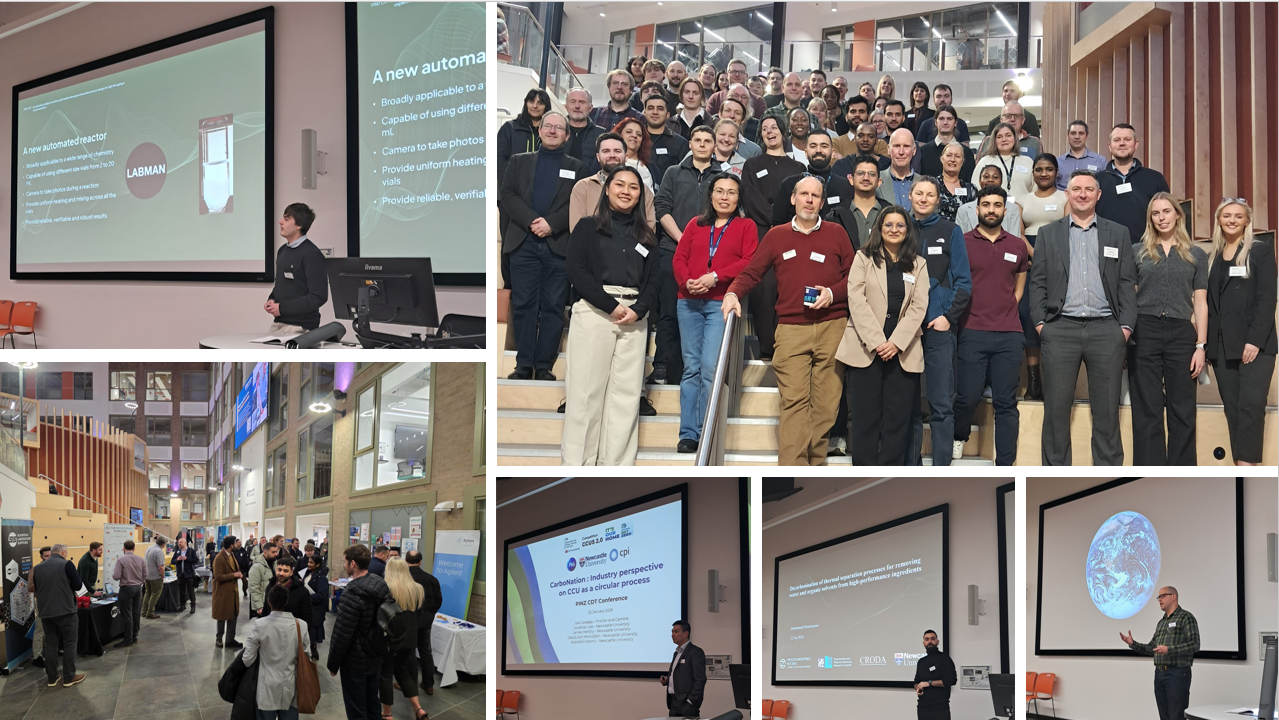
Wednesday 14 April 2027, 12:30 – 17:30, followed by a Networking & Street Food Evening at Wylam Brewery and
Thursday 15 April 2027, 09:00 – 15:30
Newcastle University, Stephenson Building, NE1 7RU
The Third EPSRC Centre for Doctoral Training Process Industries: Net Zero (PINZ) Conference will take place on 14-15 April 2027 at Newcastle University, Stephenson Building, bringing together researchers, industry leaders, students, and stakeholders from across the process industries.
The conference will showcase the latest advances in student-led research from the PINZ CDT, highlighting innovative solutions and emerging technologies that are helping to shape a more sustainable future.
Delegates can look forward to a stimulating programme of presentations, discussions, and networking opportunities, providing valuable insights into current research and its potential impact on industry. The event offers an excellent platform to connect with colleagues, share ideas, and explore opportunities for future collaboration.
On the evening of 14 April, attendees are also invited to join us for a Networking & Street Food Evening at Wylam Brewery, offering an informal opportunity to continue conversations and strengthen connections across the PINZ CDT community.
Further details, including the conference programme and confirmed timings and will be available soon. We look forward to welcoming you to the EPSRC Centre for Doctoral Training Process Industries: Net Zero (PINZ) 2027 Conference.
If you have issues accessing the Registration form, please contact us at pinz.cdt@newcastle.ac.uk.
PINZ CDT Students and Director Recognised at the IChemE Tyneside Member Group Annual Dinner
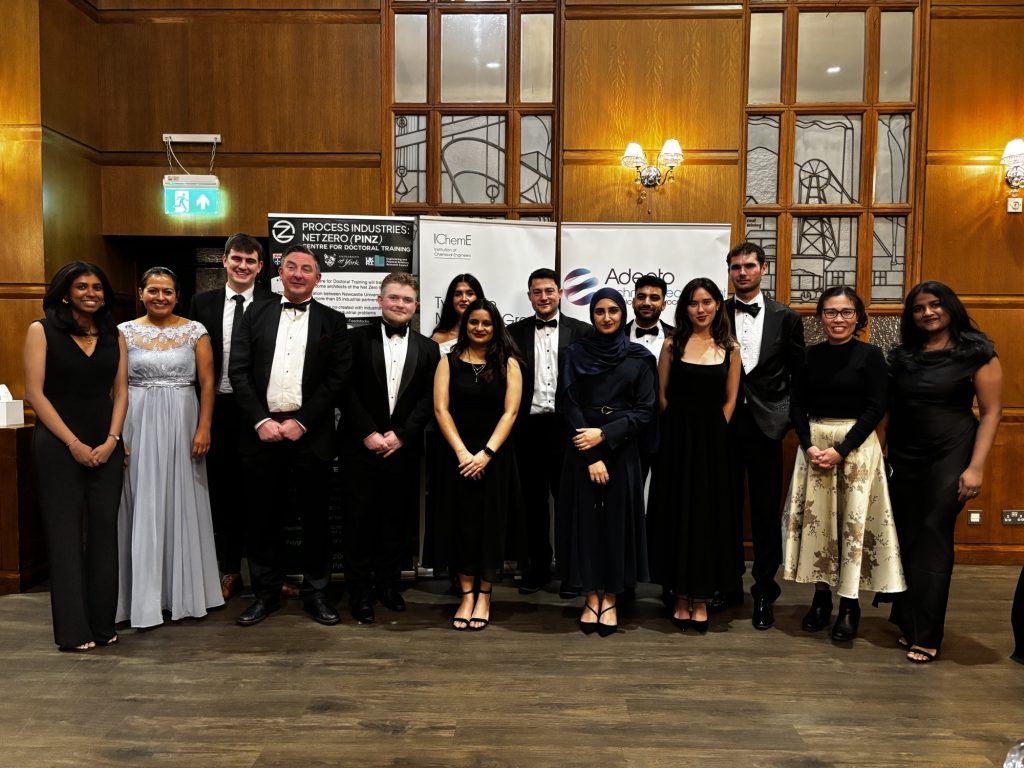
PINZ CDT staff and students attended this year’s Institution of Chemical Engineers (IChemE) Tyneside Member Group Annual Dinner on 23 October, celebrating excellence and achievement within the chemical engineering profession.
We extend our congratulations to Newcastle University MEng student and PINZ CDT Summer Placement Student, Harry Birrell, who was awarded the Engineering Student Outstanding Merit Award. We were also proud to see fellow PINZ CDT Summer Placement Students, Dilini Panditha Gedara and Thomas Pattison, recognised as runners-up in the same category.
Congratulations are also due to Professor Adam Harvey, PINZ CDT Director, who received the Distinguished Engineering Achievement Award in recognition of his outstanding leadership, innovation, and technical excellence.
The evening provided an excellent opportunity to celebrate the achievements of colleagues, students, and industry professionals from across the region.
We would like to thank Prashanth Shivakumar, the Tyneside Members Group Committee, and the IChemE team for hosting such an enjoyable and memorable event.
Welcoming a New Cohort of PINZ CDT Researchers

PINZ CDT PhD Researchers
Front row, l to r: Louise Amore-Seabrooke, Vaishnavi Jambhorkar, Anahita Shahbaksh, Jessica Ensor, Kudzaishe Chiwara, Aarcha Krishna Kalluparambil
Second row, l to r: Ben Chapman, Ellie Unwin, Lorna Younger, Max Atkinson, Evelyn Tosh, Robyn Garside, Annabel Bowkett, Mir Zuhair Ali, Amy Lumsdon
Back row, l to r: Lawrie Shrimpton, Hugh Twelves, Sam Barber, Kyle McLean, Alex Bradley, Sam Bury, Salome Usakuhyel Raymond, Ryan Masocha, Finn Jaworski, Mohammad Hosseinpour, Abdul Samad, Abubakar Kuburi, Dominic Gardiner
We were delighted to welcome our PINZ CDT Cohort 3 students from Newcastle University and the University of York to Newcastle on 2 October 2026 for our Annual Networking Day.
This event was designed to help Cohort 3 to connect with fellow researchers and the wider PINZ community. As part of the programme, students attended a Process Intensification Group (PIG) lunchtime meeting, where they heard presentations by PINZ CDT researchers Sam Bury and Dominic Gardiner. Sam delivered on a talk on the work he is carrying out with industry partner, Reckitt, while Dominic shared information on his work undertaken in partnership with Northumbrian Water.
The day concluded with a team building session for PINZ CDT researchers. This gave our newest cohort the opportunity to get to know one another better, develop new connections and begin building the collaborative relationsihps that at the heard of the PINZ CDT experience.
PINZ CDT Dragon’s Den Net-Zero Challenge


Left: PINZ CDT PhD Researchers following the Dragon’s Den Net Zero Activity
Front row, l to r: Mohammad Hosseinpour, Abdul Samad, Aditya Tiwari, Alex Bradley, Kudzai Chiwara, Vaishnavi Jambhorkar, Aarcha Kalluparambil, Max Atkinson and Abubakar Kuburi; Back row, l to r: Kypros Iavokou, Sam Bury, Annabel Bowkett, Louise Amor-Seabrooke, Ben Chapman, Zuhair Ali, Robyn Haley, Amy Lumsdon, Salome Usakuhyel Raymond
Right: Dragon’s Den Net-Zero Prize Winners
L to R: Abdul Samad, Aditya Tiwari, Abubakar Kuburi, Alex Bradley, Vaishnavi Jambhorkar, Kyle McLean, Aarcha Kalluparambil & Max Atkinson
PINZ CDT PhD researchers from Newcastle University and the University of York recently put their innovation and communication skills to the test in a Dragon’s Den-inspired Net Zero Challenge.
This interactive training activity introduced the researchers to the fundamentals of pitching net-zero research and technology ideas to potential funders and investors. Working in small teams, they identified a climate or net-zero challenge, proposed a potential technology or research-based solution and prepared a short funding pitch.
Inspired by the popular Dragon’s Den format, each team presented their idea to a panel of judges, demonstrating not only the technical merit of their concepts but also the potential for real-world impact.
Prizes were awarded for the most convincing / investible pitch, for the biggest potential climate impact and for the most creative idea.
The challenge provided students with valuable experience in translating complex research into persuasive, audience focused pitches – an essential skill for securing support for future net-zero solutions.
Congratulations to the prize-winning teams
Most convincing / investible pitch: Max Atkinson, Aarcha Kalluparambil, Abubakar Kuburi
Biggest potential climate impact: Alex Bradley, Vaishnavi Jambhorkar, Kyle McLean
Most creative idea: Aditya Tiwari, Abdul Samad
Special thank you
Special thanks to our judging panel of experts: Dr Anna Zhenova, Founder & CEO of Green Rose Chemistry; Dr Jonathan McDonough, Lecturer in Process Intensification at Newcastle University and Dr Ryan Siddall, Innovation and Partnerships Manager at Newcastle University.
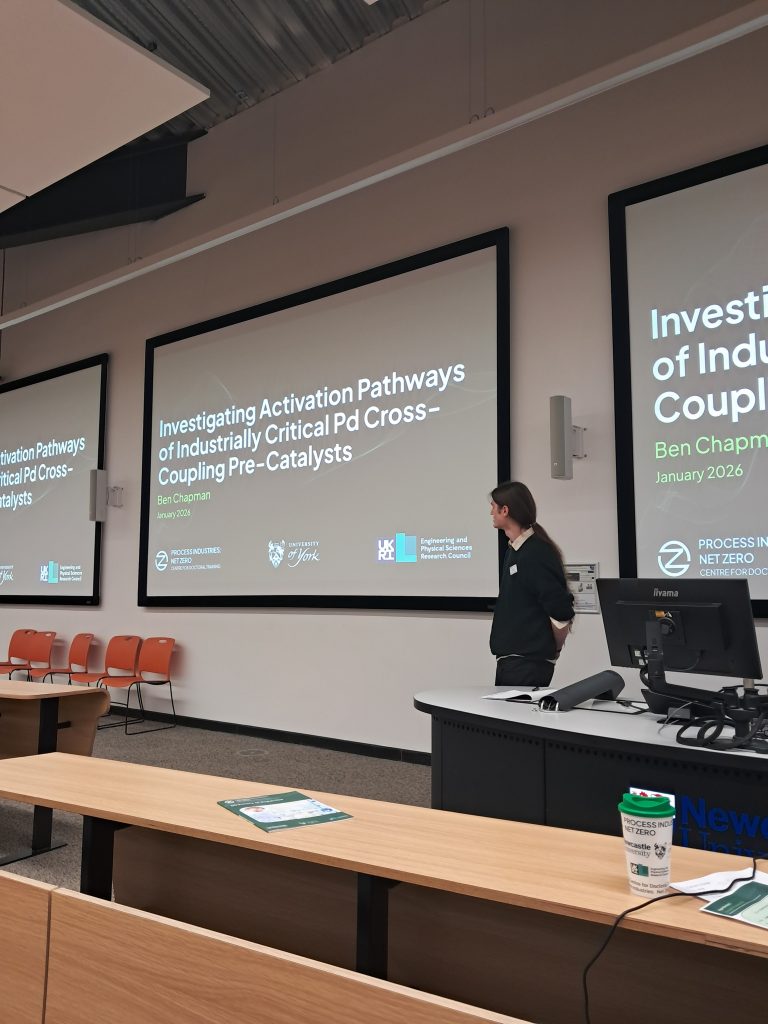
Investigating activation pathways of industry-critical Pd cross coupling pre-catalysts
Johnson Matthey(JM) is a global leader in platinum group metals (PGMs), with over 200 years of expertise in catalytic technologies. The company applies its deep knowledge of PGM chemistry to address some of the world’s most pressing challenges, from improving air quality to supporting more sustainable chemical manufacturing.
Johnson Matthey has partnered with the PINZ CDT on a project focused on improving the efficiency, robustness, and sustainability of processes that rely on homogeneous palladium pre-catalysts.
Based at the University of York, PhD researcher Ben Chapman, under the supervision of Professor Ian Fairlamb, is exploring chemical synthesis, pre-catalyst screening (supported by high-throughput experimentation and data analysis), and mechanistic studies of Pd-catalysed cross-coupling reactions.
Paula Chirila, Research Scientist at Johnson Matthey, explains more about the collaboration and its strategic importance.
What was the background to the project?
Cross-coupling reactions such as Suzuki–Miyaura and Buchwald–Hartwig are fundamental to the manufacture of high-value chemicals, including pharmaceuticals and agrochemicals. At Johnson Matthey, we are particularly interested in understanding how palladium pre-catalysts perform under industrially relevant conditions.
A key challenge is the activation of these pre-catalysts into their catalytically active forms. By gaining a deeper mechanistic understanding of these activation pathways, we can better design next-generation catalyst systems that are more efficient, selective, and robust.
This project aims to generate that understanding and ultimately support the development of improved cross-coupling technologies with reduced precious metal usage, lower waste, and enhanced process efficiency.
Why did Johnson Matthey choose to engage with the PINZ CDT?
Johnson Matthey has an established collaboration with Professor Ian Fairlamb and the University of York, and this opportunity through the PINZ CDT provided a natural extension of that relationship.
The CDT model offers a strong platform for bringing together academic insight with industrial application. It allows us to access cutting-edge research while ensuring the work remains aligned with real-world challenges and industrial needs.
The focus of the PINZ CDT on sustainability aligns closely with Johnson Matthey’s strategic priorities, including our commitment to supporting the transition to a more sustainable and low-carbon economy, as reflected in key UN Sustainable Development Goals such as good health and well-being (SDG 3), responsible consumption and production (SDG 12), and climate action (SDG 13).
How are the University of York’s facilities contributing to the project?
The collaboration combines complementary strengths. At Johnson Matthey, we bring expertise in PGM catalyst design, scale-up considerations, and industrial requirements. At the University
of York, Professor Fairlamb’s group brings strong expertise in mechanistic understanding and catalysis.
The university’s facilities play a key role in enabling the research. They are well equipped and shown themselves to be experts at the key technologies that will govern organic chemistry as well as organometallic chemistry. These include advanced spectroscopic capabilities (such as NMR), single-crystal X-ray diffraction for structural characterisation, and high-throughput experimentation platforms
How will a student benefit from undertaking a PhD through the PINZ CDT?
PINZ CDT offers a greater insight into both academia and industry, which gives the student a broader view of the life of a scientist in the academic and industry environments. In addition to core scientific training, the programme offers exposure to areas such as green chemistry, sustainability, and digitalisation.
Below: PINZ CDT PhD Researcher, Ben Chapman
Optimizing Pulse-Jet Cleaning for Sustainable Energy: A CFD Approach to Emissions Control
Founded in 1977, Durham Filtration originally set out to service the oil and gas sector with compressed air and air filtration products.
Since those early days, the company – which is based in Jarrow, Tyne and Wear – has grown to serve sectors including food and beverage, pharmaceuticals, chemical processing and power generation.
It has partnered with the PINZ CDT on a project which seeks to advance pulse-jet cleaning systems for flue gas treatment emissions control in waste-to-energy and biomass combustion plants.
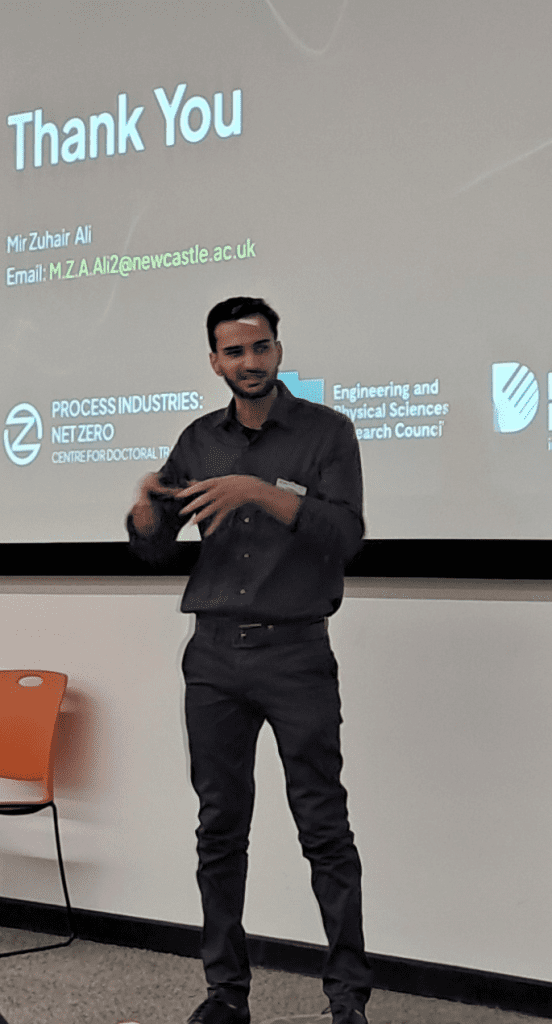
Based at Newcastle University, PhD researcher Mir Zuhair Ali is exploring how to move pulse-jet cleaning systems technology forward through using Computational Fluid Dynamics (CFD) methodologies for optimising filter cleaning processes. The end goal is enhancing filtration efficiency, reducing emissions, and improving the sustainability of energy production – aligning with both partners’ commitment to tackling climate change.
The results will feed directly into real-world applications by leveraging tools such as generative design, CAD/CAM and 3D printing.
Barry Goulden, Managing Director of Durham Filtration, explores his company’s partnership with the PINZ CDT – and the difference it is making.
How did your relationship with the PINZ CDT begin?
We undertook a knowledge transfer partnership with Newcastle University to look at how we could apply our existing filtration expertise to the biomass sector. That was highly successful, and the researcher who led that became our technical director, so we then decided that each year we would take a PhD student on, to bring more academic learning into the business.
Tell us more about the project…
Pulse jet bag filters are used to prevent ash, from the combustion of fuel, being emitted into the atmosphere. The filters are regenerative, with ash being deposited on the outside of the filter and periodically knocked off, for disposal, with pulses of compressed air. The project is looking at how this system can be designed in the most efficient way, with the optimal use of compressed air within the system.
How is Mir benefiting from working on a project through the PINZ CDT?
He’s working on real problems. For instance, he’s been able to work with one of our customers whose pulse jets have been performing poorly. That has entailed going on site visits, interacting with the customer, and being part of the wider discussion, so the project is helping him to integrate directly with industry.
Sometimes as an academic it can be difficult to understand the commercial world. But through the PINZ CDT, Mir is gaining an understanding of the commercial benefit of what he’s doing and the tangible benefits to the customer. He can see at first-hand how the pieces of the jigsaw fit together.
What particular capability, available through the PINZ CDT, is the project drawing on?
One of the most beneficial aspects is access to Newcastle University’s Rocket HPC (High Performance Computing) service. We can run the simulations we need to carry out on desktop computers, but that takes an enormous amount of time, which means you need to make compromises. Having access to the HPC systems means simulations can be run much more quickly and with a greater amount of detail. It reduces the turnaround times.
What has impressed you about working with Newcastle University’s Process Improvement Group on the project? Why should an SME with similar goals to Durham Filtration partner with the PINZ CDT?
The supervising doctors and professors see the world through very similar eyes to us in terms of the technology. It wasn’t a case of trying to get them on board – they contributed from day one.
If you’re an SME embarking on a project such as this, it can be a big step. If you pick the wrong institution to partner with, you may never do it again. But the team at Newcastle have been very proactive. And they really believe that everyone involved – the student, business and university – should benefit. They are very focused on collaboration within industry. For students aiming for careers in industry, programmes like the PINZ CDT offer excellent preparation and valuable professional experience.
Below: PINZ CDT PhD Researcher, Mir Zuhair Ali
A group of PINZ CDT Cohort 1 and Cohort 2 students recently represented the Centre at the Inter-CDT 2026 Conference, held at the University of Edinburgh.
The conference gave an excellent opportunity for students to showcase and discuss their research, exchange ideas and build valuable connections with PhD researchers from Centres for Doctoral Training across the UK.
Pictured below at the conference are (L to R): Kyle McClean, Louise Amor-Seabrooke, Abdul Samad, Amy Lumsdon, Kypros Iakovou, Robyn Haley and Dominic Gardiner.

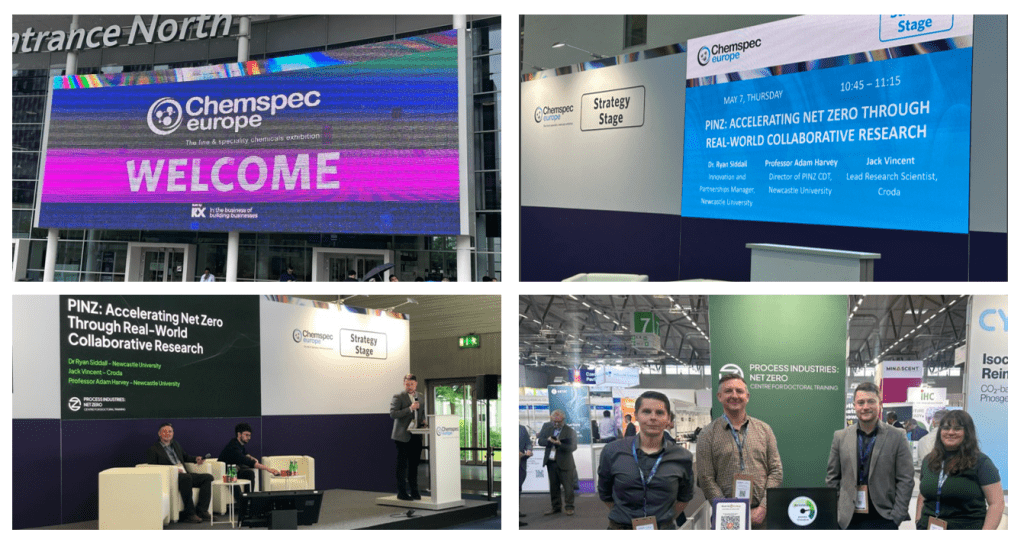
The PINZ CDT was represented at this week’s ChemSpec Europe Conference in Cologne by CDT Co-Director, Prof Adam Harvey, Academic Supervisor, Dr Jonathan McDonough, Innovation and Partnerships Manager, Dr Ryan Siddall of Newcastle University and University of York PhD researcher Hannah Chapman.
In addition to hosting a stand at the event, the team delivered a talk and chaired a panel session on the event’s Strategy Stage.
Adam and Ryan delivered a talk entitled “PINZ: Accelerating net zero through real-world collaborative research”, sharing how our CDT projects are having real-world impacts in the chemical sector.
They then joined a panel session with project industry supervisor, Jack Vincent of Croda. The discussion highlighted the value of collaborative doctoral research, featuring the PINZ CDT project “Decarbonisation of thermal separation processes for removing water and organic solvents from high-performance ingredients”, as a case study.
This PhD project is being undertaken by Mohammad Hosseinpour, with academic supervision by Dr Greg Mutch and Professor Jonathan Lee, in partnership with Croda.
Find out more about PINZ CDT Current projects.
Join us at our online open day at 10:00-11:00 on 13 May 2026 to find out more about PINZ CDT and the PhD studentships (Home UK students only) currently available to start in October 2026.
Studentships are available to Home UK students only. Each studentship includes:
- • 100% fees
- • Tax-free annual allowance of £21,805
- • £20,000 support grant
All projects are delivered in collaboration with industry partners, ensuring your research has real-world applications.
Currently available projects
• Net Zero Marine Fuels by Hydrothermal Processing of Waste – Industry partner: Purifire Ltd
• Lifecycle & Systems Modelling of Future Marine Fuels and Engine Systems – Industry partners: MaRI-UK and Babcock International
• Pathways to Net Zero: Decarbonising Cellulosic Film Manufacturing in the UK Chemicals Sector – Industry partner: Futamura
• Advanced Process Intensification Strategies for Chemical and Catalytic Reactions Using Taylor–Couette Reactor Technology – Industry partner: Laminar
• Designing the Net‑Zero Polymer Factory: Energy Efficiency, Recovery and Novel Process Technologies – Industry partner: Victrex
More projects to follow…
The open day has now passed. See information about our current opportunities here.
Applications for our undergraduate vacation studentship scheme at the University of York are now open!
Closing date: 17:00, Tuesday 5th May 2026
Scroll down for details of available projects at the University of York.
About the scheme
The scheme aims to encourage students to consider a career in Chemical Engineering/Chemistry. During the scheme, selected undergraduate students will be based at either Newcastle University or the University of York for the duration of 6 weeks over the summer to complete a short-term research project within the Chemical Engineering or Chemistry discipline.
Eligibility
Students must meet the following criteria to be eligible for the scheme:
• Be undertaking their first undergraduate degree studies (or integrated Masters)
• Be expected to obtain a first or upper second-class UK honours degree
• Be eligible for subsequent EPSRC PhD funding within PINZ CDT (i.e., UK or right to remain in the UK)
• Be in their penultimate year of studies
Applications for Projects at the University of York
To be considered for the projects below at the University of York please complete the application form below by the closing date of 17:00 on Tuesday 5 May 2026
PINZ Summer 2026 Summer Internship – University of York – Application Form
Projects available at Newcastle University and how to apply for them can be found here. Please note there is a different application process for applying for projects at Newcastle University.
Selection process and timescales
Applications will be screened for suitability and nominated candidates will be shared with the PINZ CDT panel.
Successful candidates will be notified no later than Friday 5 June 2026 with an indicative start date for the project of Monday 15 June 2026.
Payment
Students will be paid for their placement via their host institution. Both partner universities pay hourly rates which are based on the national living wage. At York this is £12.60 per hour plus holiday pay.
Reporting
Following the placement, students will be required to prepare a summary report based on the outcome of their placement. You will also be asked to deliver a short talk on your project to staff and fellow students in Newcastle University’s Process Intensification Group (PIG) or the University of York Green Chemistry Centre of Excellence (GCCE)
Available Projects at the University of York
Details of available projects at the University of York are listed below; details of available projects at the Newcastle University and how to apply for them can be found here.
Placement Title: Green chemistry: Valorisation of chestnut trees residues
Location: University of York, Green Chemistry Centre for Excellence (GCCE)
Industry Partner: Torry Hill Farm
Supervisors: Professor Avtar Matharu
Placement Description: The Green Chemistry Centre of Excellence (GCCE) is a world-leading academic facility for pioneering pure and applied green and sustainable chemical research, providing innovative solutions for a circular, sustainable 21st century economy, specialising in renewable feedstocks, green synthesis, sustainable technologies and design for sustainable reuse/degradation/recovery. We are driven by a commitment to green chemistry education and training the next generation of researchers and citizens to have a better understanding of the environmental impact of chemistry. We are signatories of the Green Chemistry Commitment, ensuring Green Chemistry education is woven throughout our undergraduate curriculum for all students, not just those taking our Chemistry, Green Principles and Sustainable Processes degrees, or our specific Green Chemistry module.
Working in collaboration with Torry Hill Farm, the placement will focus on exploitation of chestnut tree residues for high value chemicals and materials. In weeks 1- 4 the proposed research will use conventional benign solvent extraction processes to isolate extractives from chestnut tree residues and then analyse and characterise extracts and residues using ir, nmr, gc, gc-ms, hplc, lc-ms, to produce specification and functionality profiles based on feedstock. In weeks 5 to 6 the project will develop a ‘first pass’ techno-economic assessment based on results during the first 4 weeks of the project.
Although training will be provided, this placement requires a student proficient in bench chemistry, setting up reflux, monitoring reactions by TLC, using a separating flask, using rotary evaporators and analysing IR and NMR data.
Placement Title: Chemical Characterisation of Barley Steeping Effluent Organics
Location: University of York, Green Chemistry Centre for Excellence (GCCE)
Industry Partner: Simpsons Malt
Supervisor: Professor Helen Sneddon
Placement Description: This project explores whether useful natural materials can be obtained from wastewater produced during the steeping (water‑washing) of barley. This effluent has already passed through biological treatment and membrane filtration, meaning it mainly contains small, stable organic molecules (around 100–1000 Daltons). These molecules are thought to originate from the natural waxy and polyphenolic compounds that coat barley grains and help protect them from rotting in soil. Such compounds may have potential uses, for example as water‑repellent coatings for natural fibres.
The student will work on isolating these organic compounds from the effluent, separating them into individual components, and identifying their chemical nature using standard analytical techniques. Once characterised, the project will explore possible applications for these compounds by reviewing scientific literature and considering simple chemical modifications that could improve their usefulness, such as making them suitable for polymer or coating applications.